

Volume 3 Issue 1: On Boots, Shoes, and the Legacy of Leaders
July 13, 2026
Read the latest issue of the Gardner Institute Newsletter. This issue features updates on our work, news stories, and upcoming events. In his essay, Gardner Institute CEO Drew Koch explores the lasting impacts of leadership.
Continue reading below and sign up for our next issue.
On Boots, Shoes, and the Legacy of Leaders
Systems fade. Their consequences remain.
Andrew K. Koch, PhD, Chief Executive Officer, Gardner Institute
July 2026
I’m the son of German immigrants. German was spoken in our home, and it is difficult to say whether German or English was my first language. In truth, I grew up with two first languages, often used interchangeably in the same conversation. My parents sent me to nursery school to strengthen my English and to German language school on Saturdays to strengthen my German. I played Little League baseball, was active in middle and high school lacrosse, marched in my town’s bicentennial parade, attended German heritage festivals, and participated in New York City’s Steuben Day Parade.
This duality often left me feeling caught between worlds. In Germany, I was “the American kid.” In the United States, I was “the German kid.” I never felt fully at home in either culture but instead occupied the space between them. Years later, while pursuing my Ph.D. in American Studies, I learned there was a name for this experience: cultural liminality.
As a child, I disliked my liminal existence. I wanted to firmly belong somewhere. As an adult, I have come to see it as a gift. Moving between cultures has taught me to see the world through multiple lenses – to view one culture from the vantage point of another and then reverse the perspective. International travel still provides opportunities for that kind of reflection.
That was certainly true recently when I had the privilege of participating in the 20th European First-Year Experience Conference at the University of Szeged in Hungary. In the days leading up to the conference, my wife, several colleagues, and I spent time exploring Budapest. Perhaps because I have spent much of my life thinking about how history, identity, and institutions shape one another, two monuments in particular captured my attention.
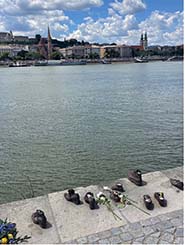
“The Shoes on the Danube Promenade” is a memorial and a monument to the Hungarian Jews who, in the winter of 1944-1945, were shot on the banks of the Danube River by the members of the Arrow Cross Party. The memorial was conceptualized by film director Can Togay and created by Togay and the sculptor Gyula Pauer.
Along the Danube, rows of bronze shoes commemorate Jewish men, women, and children murdered by Hungary’s Arrow Cross regime during World War II. Across the city at Memento Park, Stalin’s enormous boots stand as a reminder of a political system that once appeared permanent. Once.
In a profound irony, the victims represented by the shoes remain vividly present in the minds and hearts of those who visit Budapest, while the regime represented by the boots survives only as a relic of the past.
The contrast is revealing.
One memorial preserves traces of ordinary people whose lives were violently interrupted, yet whose humanity endures in memory. The other preserves traces of power. One asks us to remember lives. The other reminds us that even the most imposing leaders, regimes, and systems eventually become artifacts.
Standing between those monuments, I found myself thinking about leadership.
Are leaders making decisions to protect their power, their preferences, and their reputations? Or are they making decisions that will strengthen institutions long after they themselves are gone? Are they building systems designed to preserve their influence, or creating conditions that allow future generations to thrive?
Effective leaders understand that systems are necessary. The challenge is to continually examine them from multiple perspectives – not only from the vantage point of those who lead them, but also from the vantage point of those who experience their consequences – to understand whom they help, whom they hinder, and what unintended effects they may produce.
For those of us engaged in institutional transformation, the lesson is clear. Policies, structures, strategic plans, and operating models will all eventually change. History suggests they always do. What endures is the impact institutions have on people – and the way leaders use their authority to shape that impact.
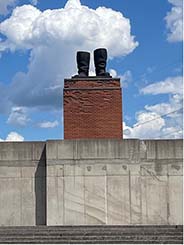
In October 1956, anti-communist revolutionaries in Budapest toppled a massive 25-meter-tall bronze statue of Stalin, cutting it off at the knees. Only the bronze boots remained on the pedestal as an iconic symbol of the regime’s fall.
Systems fade. Their consequences remain.
The question is not whether today’s systems will survive intact. They will not.
The question is what those systems, and those who lead them, leave behind.
Will future generations of students and staff remember the structures we fought to preserve? Or will they remember the lives we harmed or helped flourish? Which answer are we writing through our own leadership today?
The shoes and the boots offer very different answers to that question.