Transforming the Postsecondary Experience™ | Institution-Wide Redesign

An institution-wide approach to redesigning the first two years to improve persistence, completion, and long-term sustainability

Transforming the Postsecondary Experience™ is a comprehensive, institution-wide engagement that helps colleges and universities redesign the undergraduate academic experience, with particular focus on the first two years.

Through evidence-based, harmonized redesign of first- and second-year experiences, institutions align structures and practices to support sustained persistence, retention, and completion.

What it means to transform the postsecondary experience

Transforming the postsecondary experience means intentionally designing the undergraduate academic experience as a coherent system rather than a series of independent programs or reforms.

In this work, institutions examine how the first two years are structured, experienced, and supported across academic and administrative units. Faculty, academic leaders, and staff collaborate to identify where misalignment exists and to redesign policies, practices, and pathways so that improvement efforts reinforce one another.

The result is a unified approach to undergraduate education that strengthens persistence and completion while supporting institutional priorities related to enrollment stability and long-term sustainability.

Leadership sponsorship and institutional readiness

Institutions engage in Transforming the Postsecondary Experience™ when academic leadership recognizes that improving outcomes requires coordinated, institution-wide change rather than incremental adjustments.

Engagements are typically sponsored at the Provost level or above and supported by presidents, vice presidents, deans, and faculty leaders, depending on institutional size and structure. This leadership sponsorship creates the conditions for meaningful collaboration, informed decision making, and sustained improvement over time.

Gardner Institute partners closely with institutional leaders to guide complex conversations, align priorities, and support the collective work required to redesign the undergraduate experience at scale.

When your institution is ready to align the first two years into a cohesive strategy, Gardner Institute can help.

Who Transforming the Postsecondary Experience™ Is For

Transforming the Postsecondary Experience™ is designed for colleges and universities that recognize the need to move beyond disconnected initiatives and toward harmonized, institution-wide redesign of the undergraduate experience.

This work is a strong fit for institutions that:

  • Are prepared to harmonize improvement efforts into a single, cohesive strategy rather than managing competing priorities

  • Have senior academic leadership committed to aligning policies, structures, and practices across the institution

  • Are ready to engage faculty and staff across academic and administrative units in structured, evidence-based cycles of inquiry and improvement

  • Want to strengthen persistence and completion by intentionally designing the first two years as a coordinated, connected experience

Academic leaders from LSU–Shreveport shares why the institution joined the inaugural Transforming the Postsecondary Experience™ cohort and how partnering with Gardner Institute helped align first-year redesign efforts into a cohesive, institution-wide strategy.

Inaugural cohort institution: LSU–Shreveport

Explore Participation in the Next Cohort

What Institutions Report

Through participation in Transforming the Postsecondary Experience™, institutions describe several consistent outcomes associated with institution-wide, evidence-based redesign of the first two years.

  • Stronger leadership alignment around shared student success priorities, supported by structured assessment and facilitated sensemaking

  • Greater clarity about institutional barriers affecting persistence and completion, including fragmented advising, course sequencing challenges, and misaligned policies

  • A shift from disconnected initiatives toward coordinated, institution-wide redesign of first- and second-year structures and practices

  • Increased institutional capacity to sustain improvement through expanded use of data, clarified governance, and shared responsibility across faculty and staff

  • Early indicators of improved persistence and retention at some institutions, shaped by local context and implementation decisions

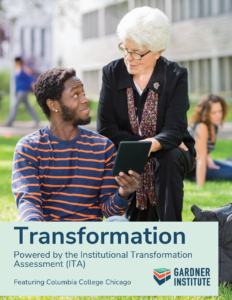
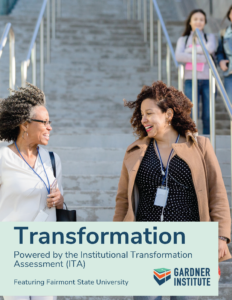
Illustrative institutional examples documented in
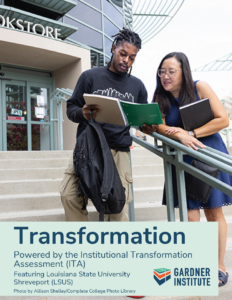
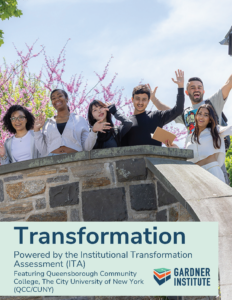
Transformation Powered by the ITA, featuring LSU–Shreveport, California State University San Bernardino, and Queensborough Community College.

What Participation Involves

Institutions begin with structured assessment to establish a shared understanding of current strengths, gaps, and readiness for large-scale redesign.

Using Gardner Institute’s Institutional Transformation Assessment and facilitated sensemaking, leadership teams and cross-functional stakeholders examine institutional data, surface systemic barriers, and identify high-impact priorities for redesign of the first two years.

This process creates a common foundation for decision making and aligns leaders, faculty, and staff around a shared direction for change.

Transforming the Postsecondary Experience™ is supported by intentional leadership alignment and clearly defined governance structures.

Institutions establish sponsorship, roles, and decision-making processes that enable coordinated action across academic and administrative units. This alignment helps move redesign work out of isolated initiatives and into institution-wide practice.

Leadership engagement is sustained throughout the engagement to support momentum, accountability, and long-term implementation.

Guided by assessment findings and institutional priorities, colleges and universities focus redesign efforts on the first two years of the undergraduate experience.

This work may include examination of academic pathways, advising structures, gateway courses, and policies that shape early student progression. Rather than adding new programs, institutions redesign existing structures and practices so they work together more effectively.

The goal is a more coordinated and predictable early undergraduate experience that supports persistence and retention.

Throughout the engagement, institutions build internal capacity to sustain redesign beyond the formal cohort period.

Faculty and staff strengthen their ability to use data, collaborate across units, and integrate redesign work into ongoing planning and review processes. This capacity building supports continuous improvement and helps institutions maintain progress over time.

Transforming the Postsecondary Experience™ is designed to support lasting institutional change, not one-time interventions.

Engagement Process and Timeline

Discovery Phase

Institutions begin with a focused discovery phase to establish a shared understanding of current conditions, readiness, and institutional priorities related to the first two years. Through structured assessment and facilitated sensemaking, leadership teams and cross-functional stakeholders examine institutional data, surface institutional barriers, and identify opportunities for coordinated redesign.

Capacity Development and Planning Phase

Following discovery, institutions focus on building the internal capacity and alignment needed to support effective redesign. This phase emphasizes leadership alignment, governance structures, and planning processes that clarify roles, decision-making, and priorities. Institutions develop a clear, institution-wide roadmap that guides redesign efforts across academic and administrative units.

Initial Redesign Phase

With capacity and planning in place, institutions begin initial redesign of first- and second-year structures, practices, and policies. Redesign efforts focus on improving alignment across academic pathways, advising structures, and early undergraduate experiences. Rather than launching new initiatives, institutions redesign existing systems so they work together more effectively to support persistence and retention.

Ongoing Redesign and Scaling

Institutions continue redesign work by refining, scaling, and sustaining changes over time. Ongoing redesign and scaling integrate improvement efforts into regular planning, review, and governance processes. This phase supports long-term sustainability by embedding redesign into institutional systems rather than treating it as a time-limited project.

Cohort Structure and Fees

Transforming the Postsecondary Experience™ is offered through a cohort-based engagement and accepts applications on a rolling basis.

Fees are structured based on an institution’s undergraduate enrollment and reflect the scope, duration, and level of support provided through the engagement. Specific fee information is available upon request.

This work is supported in part by Ascendium Education Group, the Gates Foundation, the Greater Texas Foundation, the ECMC Foundation, the Lumina Foundation, and The Kresge Foundation.

Gardner Institute is currently accepting applications for Cohort 4. Institutions interested in participating may request additional information by contacting info@gardnerinstitute.org.

Funding Partners

Data

colleges and universities have participated in one or more of our services and over 5 million students served.
0
73.9% of students leave during the Foundational Postsecondary Experience
0 %
made by participants in retention revenue for every $1 used to work with us
$ 0

Upcoming Events

13 Apr 2026

Contact Us

    Updated January 26, 2026 Katie Locke